Training from Both Sides: Nick Attard on Lived Experience, Restraint and Safety
Why Lived Experience Matters in PMVA, De-escalation and Restraint Training
In safety, conflict management and PMVA training, lived experience is often talked about as an important part of learning. But for BR Specialists, it is not a phrase used lightly.
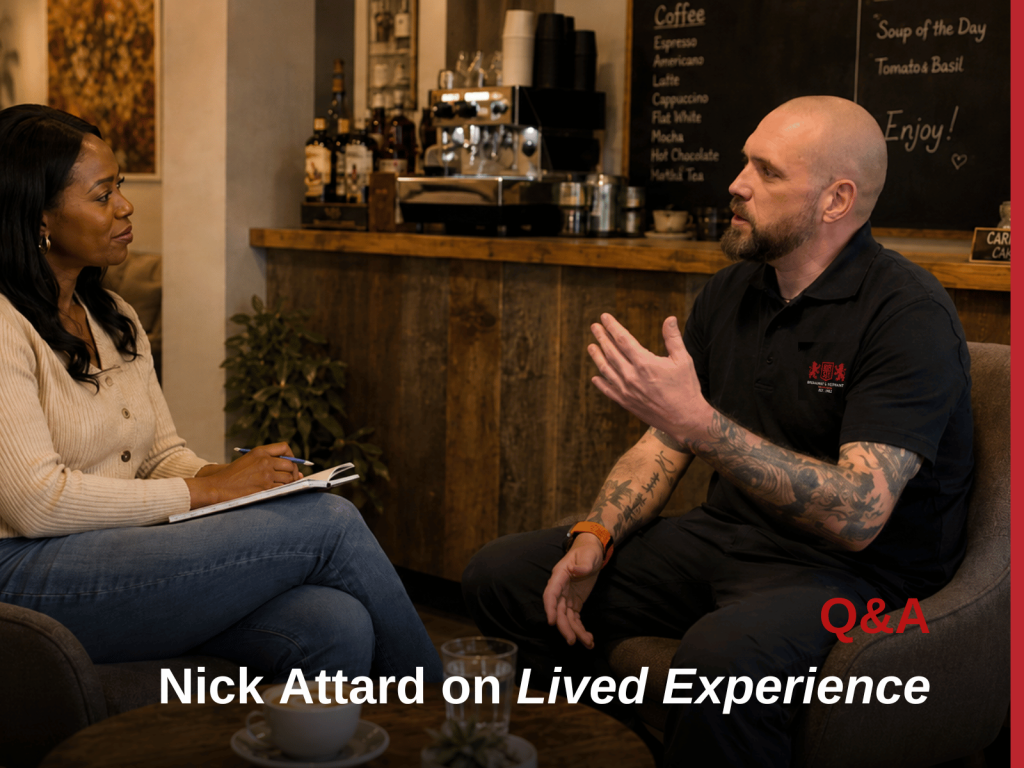
Nick Attard, General Manager at BR Specialists, brings experience from both sides of the issue. He has worked as a staff member managing violence and aggression in real-life workplace situations, but he has also experienced restraint as a patient within mental health services.
That perspective shapes the way BRS delivers training. It brings practical understanding, emotional insight, and a clear focus on keeping people safe while preserving dignity wherever possible.
Q&A with Nick Attard, General Manager at BR Specialists
When you talk about lived experience in relation to BRS training, what do you mean?
When I talk about lived experience, I mean that I have experienced both sides.
I have been a staff member who has had to use restraint in real-life situations and manage violence and aggression in the workplace. But I have also been the patient. I have experienced what it is like to be restrained during a mental health crisis.
That means I understand restraint not just from the staff perspective, but from the perspective of the person receiving it. I know what it feels like to be in that position. That gives me a different level of understanding when I deliver training, because it is not just something I have read in a book or learned in a classroom. It comes from real life.
Can you share an example from your own experience that still influences how you train today?
One example I often talk about in training happened when I was a patient on suicide watch.
At the time, I had not been taking care of myself properly. As I began to feel a little better, one of the things I wanted to do was shave and start looking more presentable again. I found a razor in my toiletry bag, which should have been checked by staff, and I stood in the doorway asking if I could have a shave.
Instead of anyone speaking to me or asking me to put the razor down, I was rugby tackled and taken to the floor.
I understand why the staff saw risk. I was on suicide watch and I was holding a razor. But the situation could potentially have been handled very differently with simple communication. Someone could have said, “Nick, can you put that down?” or “Can you pass that to me?”
That experience has stayed with me because it shows how important communication is before anyone goes hands-on. Sometimes restraint is necessary, but sometimes it can be avoided by taking a moment to speak to the person.
What did that experience teach you about de-escalation?
It reinforced how important communication is.
De-escalation is not just a technique you pull out at the last moment. It is built through how staff talk to people, how they get to know them, and how they understand what is happening before a situation reaches crisis point.
If someone had spoken to me in that moment, the situation may have been resolved very differently. There was still risk, but there was also an opportunity to communicate. That is why we place such a strong emphasis on understanding the individual, not just reacting to the behaviour.
You have said that people should not be treated like a number. Why is that so important?
Because when people feel like they are being treated as a number, situations are more likely to go wrong.
From my own experience as a patient, the staff I was more likely to listen to were the ones who had taken the time to get to know me. They had spoken to me before. They seemed genuinely interested in me as a person.
The situations that did not go well were often with people who seemed like they did not care or were just there to complete a task. When there is no personal connection, it is much harder to build trust in a crisis.
That does not mean staff have to know everything about someone’s life. But it does mean that kindness, fairness and communication matter. They can change how a person responds when things become difficult.
What do staff sometimes misunderstand about people in distress?
One of the biggest things is that a person’s reaction is not always about the staff member as an individual.
A patient or service user may be frustrated with the system, the environment, the situation they are in, or what they feel is happening to them. It can come out as anger or aggression, but that does not always mean it is personal.
That is why relationships matter. If staff know the individual, they are more likely to understand what is really going on. They are more likely to recognise what helps, what does not help, and when the situation is starting to escalate.
It is about seeing the person, not just the behaviour.
So restraint is not always avoidable?
No, and that is an important point.
I have also been in situations where I was not in the right frame of mind, where I was angry, distressed, lashing out, causing damage or trying to harm myself. In those moments, conversation was not going to work. Restraint was necessary to keep me and others safe.
That is why I do not teach that restraint should never happen. That would not be realistic. What I teach is that restraint should be avoided where possible, but used properly when it is necessary.
The skill is knowing the difference.
How do you balance personal insight with professional training standards?
The personal insight does not replace professional standards. It strengthens them.
Our courses still need to be practical, structured and appropriate for the setting. They need to be tailored to the client, not delivered as a one-size-fits-all package. But lived experience helps us look at the situation from more than one perspective.
It helps us focus on what can be done before restraint is needed. How do we communicate? How do we understand what is happening for that person? How do we avoid going hands-on too quickly?
At the same time, I also know from personal experience that there are situations where restraint is necessary. Sometimes it is the only option left to keep someone safe. The important thing is that it is done properly, proportionately, and for the shortest time necessary.
How does that lived experience affect the way BRS teaches physical intervention?
It affects it massively.
The techniques we teach are based on what works in real-life situations. Too often, techniques can look good in a training room but fail when they are needed in a real incident.
Because I have experience as both staff and patient, I can look at restraint from both sides. Does this work for staff? Does it keep them safe? Does it reduce risk? But also, what does it feel like for the person being restrained? Is it proportionate? Is it causing unnecessary pain or harm?
The aim is always to use the least restrictive method that is suitable for the situation. You do not go in with an excessive response if a lower-level hold would work. You respond to what is being presented in that moment.
What does “least restrictive” mean in real terms?
It means using only what is necessary to keep people safe.
A restraint should not be about control for the sake of control. It should be about safety. The goal is not to hold someone for as long as possible. The goal is to bring the situation to a point where that person is safe enough to be released.
Restraints rarely go perfectly. Anyone who has worked in real situations knows that things can change quickly. That is why the training has to be realistic, and why staff need to understand levels of response.
We should always be asking: what is the safest, most proportionate way to manage this situation right now?
Do people listen differently when you share that experience?
Yes, I think they do.
When I talk about my experience as a patient during training, people tend to respond very positively. They appreciate that I am not just talking about theory. I am speaking from something I have personally experienced.
It gives the training more credibility because delegates can see that I understand the practical side of restraint and safety, but also the emotional and human side of being the person in crisis.
What would you say to NHS, care, education or frontline organisations reviewing their training?
I would say make sure the training you bring in is actually fit for purpose.
Do not just look at whether it sounds good on paper. Look at whether the people delivering it have real experience of the situations your staff are facing. Look at whether the training is tailored to your setting. Look at whether it prepares staff for real-life incidents, not just classroom scenarios.
For me, lived experience matters because I have been on both sides. I know what it is like to use restraint, and I know what it is like to receive it. That helps us build training that is practical, honest and focused on safety for everyone involved.
—
Thanks to Nick for sitting down with us and sharing his experience.
For organisations working in healthcare, care, education, mental health or frontline services, lived experience should not be seen as an optional extra. It can be the difference between training that sounds right in theory, and training that prepares people for the reality of keeping others safe.